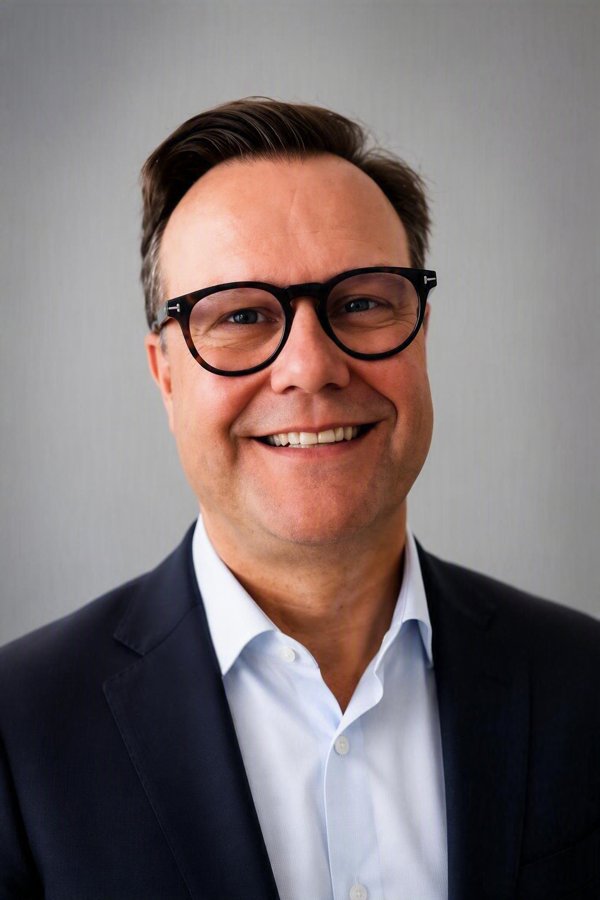
John Milland Klein
John Milland Klein
VP, Head of Aftermarket Parts and Technical Support at Nilfisk
Background and motivation
When I started at AVT, I was working at Grundfos. We were in the process of establishing a new separate business unit for service and digital solutions. We separated the entire service organisation from the operations organisation, while part of the digital area also fell within our remit. There was therefore a great deal of work involved in determining where we wanted to go in the future.
I had always tried to keep my knowledge up to date, but in that situation, I realised that I needed fresh insights - particularly within innovation and strategy. Quite frankly, I needed to learn something new.
Why AVT?
Grundfos also used IMD in Switzerland, so that was an option. However, a colleague from our development department, who had completed a programme at AVT herself, recommended that I take a closer look at it. I spoke with her, and it sounded interesting - both as an educational institution and because of the way the programme was structured.
What particularly appealed to me was the exceptionally strong faculty and the modular structure. I liked the flexibility, while still having the sense that it formed one coherent package. One of the greatest strengths was that the professors came from outside AVT and had international backgrounds. That provided a different perspective.
At a Danish university, you will often be taught by the institution’s own faculty, who I am sure are great, but here, both the academic standard and the breadth of perspective were elevated. I do not know whether I fully understood how important that would be before I began, but during the programme, it became a major strength. It is simply impossible to overstate the quality of the faculty.
Learning environment and format
How did you experience the environment at AVT - both the teaching and your fellow participants?
It was professional, yet also close-knit and personal. We got to know each other well, and the same applied to our relationships with AVT’s staff, which felt very personal.
I also liked the modular structure and the opportunity to step away for a few days, sit down and focus entirely on the teaching. You absorbed an enormous amount, while there was still room for direct discussion and lively back-and-forth in the classroom.
“Accommodating” is perhaps a good word to describe the learning environment - you felt welcome. I have also completed a HD at a university, and that experience could sometimes feel a little like “in, out, and on to the next” - almost like a production line. At AVT, I never felt that I was simply one of many, and that is still how I experience it today.
At the same time, it makes a great difference to have a professor in front of you who genuinely knows the subject and with whom you can engage in discussion. That appeals to me much more than pure self-study or a digital module completed alone.
Professional and academic takeaways
Is there anything in particular from AVT that you have brought with you into your new role?
The programme has given me a great deal in terms of working with strategy - both when diving into a new subject, but also in carrying out the work. I have also gotten a better understanding of innovation and finance as a whole.
It had been about 20 years since I graduated as an engineer, so the programme represented a significant academic and professional step up for me. I had, of course, completed courses along the way, but not a longer and more in-depth programme. It made a major difference to return to education and once again learn to think strategically, systematically and analytically.
I still use some of the books and a lot of the models from the programme. Perhaps more importantly, I continue to use the approach to exploring new subjects that the programme gave me.
From Grundfos to Nilfisk
The work of separating the service function at Grundfos began around 2016. A few years later, I was asked whether I would like to do something similar at Nilfisk - in other words, help establish a global service organisation. I said yes because it sounded really exciting.
That is also what I continue to work with today: developing a global service organisation.
I believe the MBA has also been an important part of my career path. I doubt I would have reached the position I am in today, had I not completed it. It is not necessarily that an MBA makes you smarter, but it does open new doors. The right education and access to the right faculty can create opportunities that might otherwise not come up.
Today, I have a global responsibility in an international organization within an area that is central to both Nilfisk's business and the overall customer experience, and I am quite certain that I would not have gotten my current role without the MBA. It was quite simply a prerequisite for being considered in the first place. I therefore see the programme as an important enabler of where I am today.
It also says something about your drive. When you commit to a demanding programme, you have to perform and see it through. I have taken that experience with me in my career.
Workload and family life
I think it depends greatly on the family you are part of and the arrangements you agree upon. My children were probably a little older, and my wife, Annemette, and I took a fairly structured approach to it. With clear agreements within the family, it is possible to make it work. That is easy to say in hindsight, but it worked for us.
When I had an assignment to write, I would typically shut myself away for an entire weekend. I might go to the summer house and close the door behind me. I could then complete the assignment over the following week or week, but I was not necessarily working on it every single evening.
Of course, it was intense. Family activities, personal life and sport occasionally had to take a lower priority. It is therefore important to be clear about what you are committing to and to have the necessary arrangements in place.
What I wish I had known
I began the programme because I had identified a personal need. I wanted to learn something new and gain a better understanding of what was happening around me.
What surprised me most positively was the combination of the exceptionally high standard of the faculty and the intimate, close-knit environment. I had not really anticipated that beforehand. You also build a network and meet people who are working with many of the same challenges as you are.
The teaching was of a very high quality, the subjects were well chosen, and you always felt welcome. Mentally, I had prepared myself to go in, complete an MBA and leave again - much like when I completed my HD. At AVT, the relationships and the learning environment became a far more important part of the experience than I had expected.
The workload itself, on the other hand, should not come as a surprise. When you commit to a programme like this, you know that you will have to work hard. Otherwise, you should not do it, because you would only be fooling yourself.